
The History of Abergavenny Local History Society
In the 1950s, a small group of Abergavenny people were determined to save the crumbling Castle House, built in the early 1800s on the castle keep, and establish a museum there. Gwyn Jones, who had recently joined King Henry VIII Grammar School as head of history, joined them and brought working parties of senior pupils at weekends. The original group became the Friends of the Museum who raised funds enabling the Museum to open in 1959.
1960s
The Abergavenny Archaeological Society, who had a long term association with ALHS, tackled the medieval town, finding the site of the Roman Fort and other remains. They also helped with excavations at the Iron Age Fort, Twyn-y-Gaer in 1968.
1970s
When in 1971 the Museum was taken over by Abergavenny Council, the Friends of the Museum missed the activity and two members of the group, Freda Key and Ruth White, suggested forming a history society. This idea was enthusiastically taken up and at the inaugural meeting on 30th November 1977 Gwyn Jones became the first chair of Abergavenny Local History Society with the lectures programme starting on 19th January 1978. The membership fee was £6 a year. Initially the group met at Harold Road Girls School (now Cantref Primary School) before moving to the Scout Hut in Fairfield Car Park. The Society outgrew the Scout Hut’s facilities and moved to the ballroom in the Angel Hotel and from there to the Borough Theatre.
1980s
Wintertime lectures in the Borough Theatre were alternated in the summer with visits to places of historic interest. During the 1980s, members of the society researched more than 200 premises in Abergavenny town centre and produced the Abergavenny Street Survey. This original survey is still available for study in Abergavenny Library and Gwent Archives. In addition, individual members researched and published several books about Abergavenny in the past. In 1985, the society received the award ‘History Society of Britain’ from the Association of Local History Societies, and the Committee and their spouses celebrated at the castle.
The Summer Newsletter was started in 1985 by Freda Key and, following Freda’s untimely death in 1989, continued by Ken Key (now our President) until his 94th birthday in 2019. The Society ran an annual photographic competition, for the best set of three slides or prints with a historical connection or showing Society activities.
Between December 1982 and April 1985 the Society erected nine Blue Plaques at sites of historic interest in the town. By 1989 the Abergavenny Castle Floodlighting had been installed by the Society and a sponsorship system set up to cover the running costs. Also by this time the Garden at the Castle had been established with a medieval herbal theme and this is still maintained by ALHS volunteers, though it now has a Victorian theme.
1990s
In 1990, as part of the ‘Abergavenny 900’ celebrations, the Society ran a local history competition for schools to enter a project or study covering any aspect of local history in the NP7 postcode area, between 1090 and 1990. The prize of the Freda Key Plaque was won by Harold Road Junior School.
The Society’s close connection with St Mary’s Church had continued with the formation of ALHS Churchwatch, meaning that ALHS volunteers greeted visitors at the church on Wednesday afternoons to answer questions or give a tour of the church. The ALHS Churchwatch group closed a few years ago and the church now provides all the greeters.
In 1993 St Mary’s Priory Church formed a ‘Monuments Restoration Fund’ which ALHS members were very much involved in, raising £159,000 towards restoring the famous monuments in St Mary’s Church.
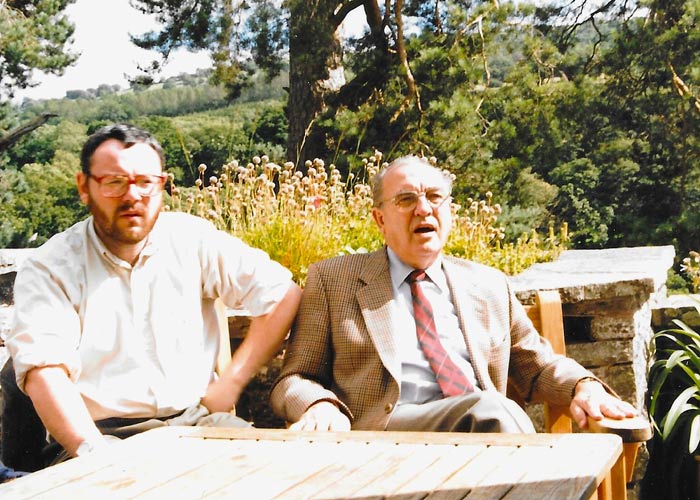
In 1997 Gwyn Jones stood down as Chairman of ALHS and was replaced by Frank Olding who was then Curator of Abergavenny Museum. They are shown together in the photograph above. Also in 1997 the Summer Newsletter was produced for the first time on Ken Key’s new computer, rather than being typed.
ALHS membership stood at 200 members by the end of the decade and Richard Davies was the new Chairman with Irena Morgan as Secretary.
2000s
A Society website was made to inform the public and members of the Society’s activities and this went live in 2001. As members became more familiar with modern technology the Society’s communications moved gradually to email rather than post and telephone. The Membership fee rose to £10.
Additional Blue Plaques were put up in 2002 in Nevill Street, Market Street and the Town Hall among other places, making a total of 23.
A major oral history project was undertaken which resulted in the publication of ‘A Town Remembers, memories of wartime Abergavenny’ in 2003. Also in 2003 the Summer Newsletter contained colour photographs for the first time.
The Society was granted Charity status in 2003
The Research Group was formed, initially to undertake research into the history of Abergavenny Castle in the 19th century and up to when Museum opened, but many other projects have followed.
In 2005 the Herb Garden at the Museum was renovated and became the Victorian Garden with the help of grants from several organisations. Community involvement led to groups of schoolchildren coming to plant bulbs in the garden each autumn.
Also in 2005 the Society got involved with the Town Council’s 60th Anniversary of VE Day celebrations with dressing up appropriately much in evidence in the procession.
The Society had always held social events for members, the December meeting being a social one from the early days. The Quiz Night with Fish and Chip Supper remained popular for many years.
Irena Morgan took over as Chair in 2005 and she was followed by Gill Wakley in 2009 who led the Society into making the technical changes needed for flourishing in the 21st century as well as improving the Society’s credentials for researchers and mastering all the intricacies of Charity Commission rules and the new Data Protection Laws.
Coffee and tea had always been served to members at lectures, as one of the perks of their membership, and in 2007 it was decided that only Fairtrade products would be used.
The Society commissioned a video of the history of Abergavenny – ‘The Abergavenny Story: from Stone Age to Our Age’. A number of copies were sold but it never achieved the success envisaged by the Society and was soon quietly forgotten.
In 2008 the Society decided to commission a new set of ceramic plaques to go up around the town. These are specially aimed at children and are placed at a child-friendly height.
2010s
The Society had for some years been leading walks around town for visitors that included many of the most historically interesting buildings. They gradually became less popular but ALHS still provides these on request. Several booklets were written to accompany these walks.
More publications by ALHS members helped to put the Society on the map. Many aspects of research continued and articles accepted for journals.
The Street Survey was updated and a new website made for it. This site has since provided invaluable for many family historians as well as those interested in Abergavenny town’s history.
When the National Eisteddfod came to Abergavenny in 2016 the organisers did not appear to welcome input from local organisations but the Society did organise several town tours in Welsh during the event.
2020s
The website was revised, relocated, and is continuing to be updated. The Covid restrictions meant a break of a few months before lectures were again possible, now via Zoom from the lecturer’s home. They returned to the Borough Theatre post pandemic but also with some hybrid meetings during the winter months hosted at the Melville Theatre, as live online lectures had proved popular with a lot of the members.
The Membership fee increased to £15 pa and has more recently risen again to £20 pa, largely reflecting the rising costs of putting on lectures. After Gill Wakley had spent quite some time attempting to find her replacement, Frank Olding was persuaded to take over as Chair for a second time in 2023.
The Society contributed much of the information about Abergavenny found on the new History Points QR codes which have appeared on many of the town’s old buildings. Visitors can scan the code with their phones to reach information about the building beside them, or go direct to the website.
The Ceramic Plaques Trail around the town was researched by the society with local schools who proposed many of the themes illustrated on the plaques, as well as on the information stones to mark the 1913 Eisteddfod Circle in Swan Meadows.
The Street Survey website was given a new look and better search facilities and can now be found at www.abergavennystreetsurvey.co.uk .
Current membership stands at just over 300. The society depends on its members for its activities and always welcomes new enthusiasts!